

We ship to all 50 states from our own GMP-certified facility in the UK — typically 5–8 business days, with duties calculated at checkout so there's nothing to pay on delivery. Prices shown in USD. See the PCT range →
Last reviewed: July 2026. This article explains what post cycle therapy is and how it works. It does not provide dosing protocols for prescription medicines, and it is not a substitute for medical advice.
The short version
If you've used anabolic steroids, prohormones or SARMs, your body has almost certainly stopped making its own testosterone. Post cycle therapy (PCT) is what you do to get it started again.
Done properly it involves a doctor, prescription medication and blood tests. Done badly — or skipped — it can leave you suppressed for months, and in some cases the shutdown doesn't fully reverse. Most of the horror stories in this space are not about the cycle. They're about what happened afterwards.
This guide covers what's actually going on in your body, when to start, what to get tested, and — honestly — where an over-the-counter supplement does and doesn't help.
Why your testosterone shuts down in the first place
Your natural testosterone production runs on a feedback loop called the HPG axis — hypothalamic-pituitary-gonadal. It works like a thermostat:
- Your hypothalamus releases GnRH.
- That tells your pituitary to release LH and FSH.
- LH tells the Leydig cells in your testes to produce testosterone. FSH drives sperm production.
- Your brain detects the resulting testosterone and oestrogen, and dials GnRH back down.
When you introduce testosterone or any androgen from outside the body, step 4 goes into overdrive. Your brain sees plenty of androgen in circulation and concludes it doesn't need to ask for any more. GnRH drops, LH and FSH drop, and your testes — receiving no signal — stop producing. Given long enough, they also shrink.
When the cycle ends, the external androgen clears. But the signal doesn't automatically switch back on. You're left with no exogenous testosterone and no endogenous testosterone, which is the window where people feel genuinely terrible: flat mood, no libido, no energy, and rapid loss of the size they just spent months acquiring.
The entire purpose of PCT is to shorten that window.
Important, and the internet gets this backwards constantly: if you are on medically prescribed TRT, you do not run PCT. TRT is intentional, permanent, supervised suppression — the exogenous testosterone is the treatment. PCT is for people who intend to come off and recover their own production. These are opposite goals.
Not everything suppresses you equally
"Do I need PCT?" doesn't have one answer. It depends heavily on what you ran, how much, and for how long. Broadly:
| What you used | Typical suppression | Recovery outlook |
|---|---|---|
| AAS (injectable or oral) | Severe. Near-total shutdown of LH and FSH. | Recovery is rarely spontaneous or fast. Medical PCT is the norm, and bloodwork is essential. |
| SARMs | Variable, and consistently worse than marketing claims. Suppression is well documented even at "low" doses, and increases with dose and duration. | Some people recover unaided over weeks to months. Many don't, and needed intervention. "SARMs don't need PCT" is one of the most costly myths in this space. |
| Prohormones / designer androgens | Suppressive. They convert to active androgens in the body — the mechanism is the same as AAS. | Treat as you would a mild AAS cycle. The "it's just a supplement" framing does not change what it does to your HPG axis. |
| Natural test boosters, herbals, vitamins | None. They don't introduce exogenous androgens. | No PCT needed — there's nothing to recover from. |
If you don't know which category the thing you took falls into, that's the first question to answer. Plenty of products sold as "supplements" are not.
The PCT Bloodwork Checklist
A free one-page PDF: the exact panel to ask your doctor for, when to draw it, and how to read what comes back. Print it, take it with you.
Send me the checklist One email. You'll also get 10% off your first order.When to start
Timing is the single most common thing people get wrong, and it's a simple principle: PCT only works once the suppressive compound has cleared your system. Start while there's still androgen in circulation and you're trying to restart an engine that something else is actively holding off.
How long that takes depends entirely on what you used:
- Oral compounds generally clear fastest — often within days.
- Short-estered injectables take roughly a week to a fortnight.
- Long-estered injectables can remain active for several weeks after the last injection.
This is precisely why generic timelines lifted from a forum are a bad idea. The correct start date is a function of the specific compound, its ester, your last dose and your own clearance — which is a conversation with a doctor, ideally supported by a blood test confirming the compound has actually left your system.
The bloodwork that actually tells you something
Without bloods you are guessing, and PCT is not a thing you want to guess at. This is the panel worth asking for — ideally a baseline before the cycle, then again once the compound has cleared, then again 4–8 weeks after PCT ends.
| Marker | Why it matters |
|---|---|
| Total testosterone | The headline number. On its own it doesn't tell you whether recovery is happening. |
| Free testosterone | The fraction that's biologically active. Can be low even when total looks acceptable. |
| LH & FSH | The ones that matter most. These tell you whether your brain has started signalling again. Testosterone rising with LH still flat means something else is going on. |
| Oestradiol (E2) | Drives a lot of the symptoms people blame on low testosterone. Ask for the sensitive assay. |
| SHBG | Determines how much of your testosterone is actually available. |
| Prolactin | Relevant if libido stays flat despite testosterone recovering. |
| Full blood count, lipids, liver & kidney function | The unglamorous ones. This is where the real long-term damage from a cycle shows up. |
Draw bloods in the morning, fasted, before training. Test at the same time of day each time or the numbers aren't comparable.
What if you can't, or won't, get a prescription?
Everything above runs through a doctor. That's the honest answer, and we'd rather say it than pretend a capsule replaces it.
But it leaves a real group of people with nowhere useful to go — someone coming off a mild prohormone cycle, someone between cycles, someone whose bloods have come back fine and who simply wants to support their own hormonal balance. That's the space over-the-counter products occupy, and it's worth being precise about it.
What an OTC support supplement can do
It can make sure you aren't deficient in the raw materials your endocrine system runs on. If you're short on zinc, your testosterone production is impaired regardless of what your HPG axis is doing — and correcting that is a real, measurable thing.
- Zinc — contributes to the maintenance of normal testosterone levels in the blood.
- Vitamin D3 — contributes to normal muscle function and the maintenance of normal bones.
- Magnesium — contributes to a reduction of tiredness and fatigue, and to normal muscle function.
- DIM and botanical extracts — commonly used as part of a hormonal balance routine post-cycle.
What it cannot do
It cannot restart a shut-down HPG axis. No zinc capsule blocks oestrogen receptors at your hypothalamus. If your LH is on the floor after twelve weeks of testosterone, a supplement is not the thing that fixes that, and any brand implying otherwise is lying to you to move units.
Use it for what it's for: covering the nutritional gaps, supporting sleep and recovery, and giving your body the best possible conditions to do the job. Not as a substitute for the job.
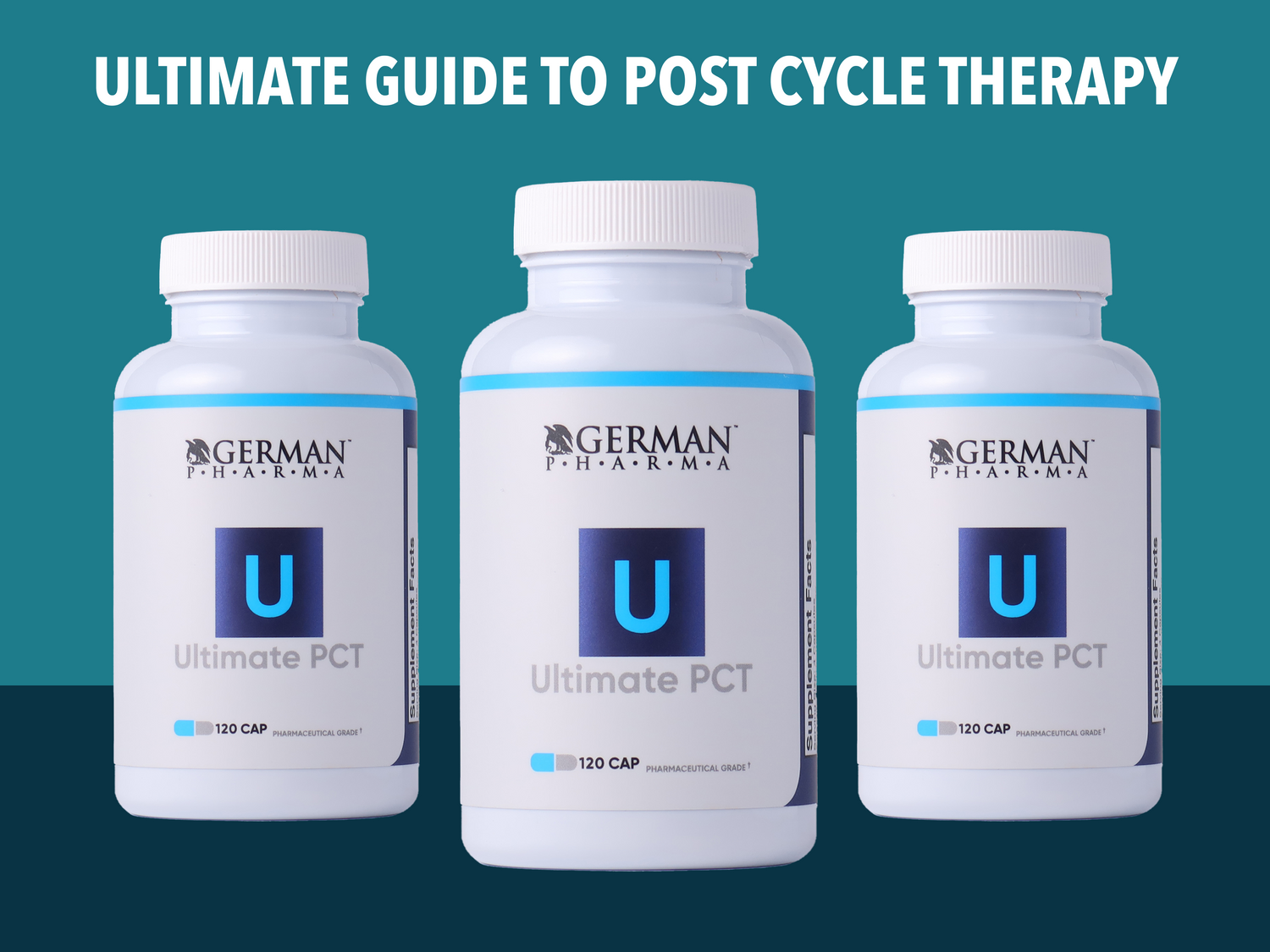
Ultimate PCT — Post Cycle Support Stack
Zinc, magnesium and vitamin D3 to support the maintenance of normal testosterone levels, alongside DIM and botanical extracts for hormonal balance. Formulated and manufactured in our own GMP-certified facility — we're the manufacturer, not a reseller putting our label on someone else's powder.
It is a support supplement. It is not a SERM and we won't pretend it is one.
Shop Ultimate PCT 🇺🇸 Ships to all 50 states · Duties calculated at checkout · 5–8 business days Free UK delivery over £50 · Same-day dispatch before 3pm Food supplement. Not a substitute for a varied and balanced diet, a healthy lifestyle, or medical advice. If you're following a prescription protocol, speak to your doctor before use.Five things that ruin a PCT
- Starting too early. Running a SERM while a long-ester compound is still active achieves nothing except wasting the SERM.
- No bloodwork. You cannot tell by feel whether LH has recovered. People routinely "feel fine" while badly suppressed, and vice versa.
- Stopping the moment you feel better. Feeling better is not the same as recovered. Bloods decide when you're done, not mood.
- Cutting calories hard immediately after. A steep deficit on top of a suppressed axis is how you lose everything you gained. Eat, sleep, train sensibly, and let recovery happen.
- Thinking a supplement is the protocol. It's the support. It is not the protocol.
FAQs
Do SARMs really need PCT?
Often, yes. Suppression from SARMs is well documented and is dose- and duration-dependent. Some people recover unaided; plenty don't. Get bloods before you decide either way — that's the only way to know which group you're in.
How long does PCT last?
Most protocols run somewhere in the region of four to eight weeks, but the honest answer is: until your bloods say you're recovered. That's a range, not a rule.
Can I just do "natural PCT"?
If your suppression was mild, your bloods look reasonable, and your doctor agrees — sleep, calories, training and correcting nutritional deficiencies is a legitimate approach. If you've run a real AAS cycle and your LH is flat, no, and pretending otherwise costs people months.
Will I lose my gains during PCT?
Some drop is normal — a chunk of it is water and glycogen. The people who lose the most are the ones who slash calories, stop training hard, or skip PCT entirely and spend three months suppressed.
What if my bloods still look bad after PCT?
See a doctor, specifically an endocrinologist. Persistent hypogonadism after a cycle is a real clinical condition, it is treatable, and it does not resolve by waiting and hoping.
Do I need PCT after TRT?
That's a different conversation, and one for the doctor prescribing your TRT. Coming off long-term TRT is not the same problem as coming off a cycle.
Support your recovery properly
Get the bloods. See the doctor. And give your body the raw materials it needs while it does the work.
Ultimate PCT — the complete stack Browse all PCT productsPro-Hormones is part of JSML Global. We formulate and manufacture in our own GMP-certified facility in the UK, under some of the most tightly regulated supplement standards anywhere. Every batch is tested and a certificate of analysis is available on request — which is more than most of what's sold domestically can say.

Leave a comment
All comments are moderated before being published.
This site is protected by hCaptcha and the hCaptcha Privacy Policy and Terms of Service apply.