

Urolithin A vs Pomegranate Extract: A UK Buyer's Guide to the Real Thing
By Marc Byrne - Managing Director & Chief Formulator, JSML Global (UK manufacturer since 2008)
If you've started shopping for a Urolithin A supplement in the UK, you've probably noticed something odd: products with wildly different prices, doses listed in completely different ways, and a fair few that mention pomegranate, ellagic acid or "ellagitannin complex" on the front of the label rather than Urolithin A itself.
That isn't a coincidence, and it isn't pedantry. From where I sit - I formulate these products for a living - the gap between a bottle that says Urolithin A and a bottle that actually delivers Urolithin A is the single most important thing a buyer in this category needs to understand. This guide explains the difference, why it matters, and exactly what to check on a label before you spend your money.
First, what Urolithin A actually is
Urolithin A is a postbiotic metabolite - a compound your body produces when gut bacteria break down ellagitannins, the polyphenols found in pomegranates, walnuts and certain berries. It has become one of the more heavily researched compounds in the longevity and mitochondrial-health space, with published studies investigating its role in mitophagy: the cellular housekeeping process by which the body turns over ageing mitochondria.
That's the part the AI summaries and the listicles will tell you. Here's the part most of them skip.
The conversion problem nobody mentions
You don't eat Urolithin A. You eat its raw materials - the ellagitannins in a pomegranate - and your gut microbiome is supposed to convert them into Urolithin A for you.
The catch: only an estimated 30–40% of adults host the specific gut bacteria needed to produce meaningful amounts of Urolithin A from food. The rest of the population converts poorly, or barely at all. Your diet, your age, your microbiome composition and even your antibiotic history all affect it.
This is the crux of the whole category, and it's why the form on the label matters so much:
- A supplement built around pomegranate extract or ellagic acid is selling you the precursor. Whether you actually get any Urolithin A from it depends entirely on whether you're one of the lucky 30-40%.
- A supplement built around direct Urolithin A skips the lottery. You're taking the finished metabolite, so your microbiome composition is no longer the deciding factor.
A pomegranate extract is a perfectly good food. It is not, however, a reliable Urolithin A supplement - and the two should never be priced or compared as though they're equivalent.
Pomegranate extract vs direct Urolithin A - at a glance
| Pomegranate / ellagitannin extract | Direct Urolithin A | |
|---|---|---|
| What you're taking | The precursor | The finished metabolite |
| Relies on your gut microbiome | Yes - heavily | No |
| Works for the ~60% of poor converters | Unreliable | Yes |
| Matches the form used in human trials | No | Yes |
| Typically cheaper per bottle | Often | Reflects the cost of the raw material |
| Honest front-label term | "Pomegranate extract" | "Urolithin A" |
If a product is dramatically cheaper than everything else on the shelf and the ingredients panel leads with pomegranate, ellagic acid or a proprietary "complex," that price gap is usually telling you exactly what you're getting.
What "clinically studied" really refers to
You'll see the phrase clinically studied on almost every product in this category. It's worth knowing what it's actually pointing at.
The landmark human trials on Urolithin A were run by Amazentis (now Timeline) using their patented Mitopure ingredient - including a 2022 randomised controlled trial in older adults. Those trials used direct Urolithin A at 500mg to 1,000mg per day, not pomegranate extract. Most of the credible human research sits in that 500–1,000mg/day range.
So when a pomegranate-extract product borrows the phrase "clinically studied," it's leaning on research that was conducted on a different ingredient in a different form. That's the sleight of hand to watch for.
How to read a Urolithin A label - a formulator's checklist
This is the part I'd want a friend to know before buying. Six things, in order of importance:
-
Does it state Urolithin A as the active, by weight? Not "pomegranate extract standardised to," not "ellagitannin complex." You want a number against the words Urolithin A - e.g. 500mg or 1,000mg.
-
Is the dose in the clinically studied range? Look for 500mg–1,000mg of Urolithin A per day. Anything advertising "2,000mg" deserves a second look - check whether that figure refers to actual Urolithin A or to a blend that's mostly fruit extract.
-
Per serving, not per capsule. A label can say "500mg" per capsule and require two capsules for the studied dose. Always find the per-serving and per-day numbers.
-
Where is it made? UK GMP-certified manufacturing means the facility is audited for consistency, traceability and what's-on-the-label-is-in-the-bottle accuracy. It's a baseline, not a luxury.
-
Is there third-party or batch testing? Independent verification of identity and purity is the difference between a claim and a fact.
-
Is the capsule shell actually clean? A genuinely vegan-friendly product uses a pullulan or HPMC shell - worth checking if that matters to you.
If a product passes 1, 2 and 3, you're already ahead of most of the market. If it passes all six, you're buying from someone who has nothing to hide.
Where our Urolithin A sits
I'll be straight about ours, because the whole point of this guide is transparency.
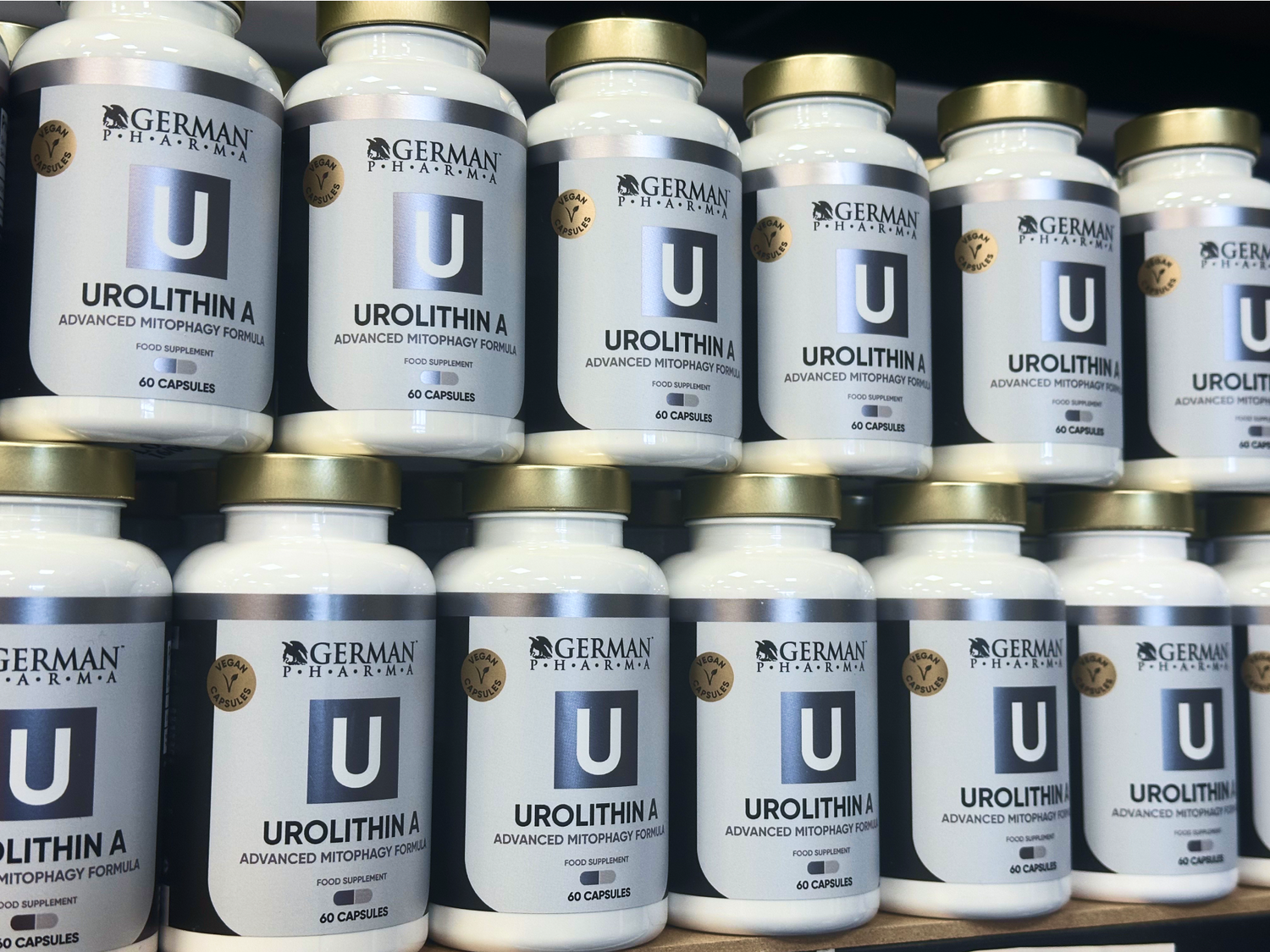
German Pharma Urolithin A is direct Urolithin A - not pomegranate extract - at 1,000mg per serving (500mg × 2 capsules). We deliberately formulated to the upper end of the clinically studied range rather than the entry point, because if you're going to take it, the research supports taking enough of it. It's manufactured in our own GMP-certified UK facility, the only other ingredient is a pullulan vegetable capsule shell, and it's suitable for vegan, vegetarian and Halal diets.
We're not the cheapest Urolithin A you'll find. A pomegranate-extract product will always undercut us on the shelf price - but now you know what that lower number actually buys.
Frequently asked questions
Is pomegranate extract the same as Urolithin A?
No. Pomegranate extract contains ellagitannins, which your gut bacteria may convert into Urolithin A - but only an estimated 30-40% of people convert efficiently. Direct Urolithin A is the finished metabolite, so it doesn't depend on your microbiome.
What dose of Urolithin A is used in studies?
Most credible human research uses direct Urolithin A at 500mg to 1,000mg per day.
How do I know if a supplement contains real Urolithin A?
Check that the ingredients panel lists Urolithin A with a weight in milligrams as the active - not pomegranate extract, ellagic acid or a proprietary blend - and confirm the per-serving dose falls in the 500-1,000mg range.
Is Urolithin A vegan?
Direct Urolithin A is suitable for vegans provided the capsule shell is too. Ours uses a pullulan vegetable shell.
Why is direct Urolithin A more expensive than pomegranate extract?
Because the raw material is the finished metabolite rather than a fruit extract. You're paying for what the studied ingredient actually is.
About the author
Marc Byrne is Managing Director and Chief Formulator at JSML Global, UK supplement manufacturer established in 2008. He has spent over 15 years formulating food supplements and sports-nutrition products under UK regulatory standards, with a focus in recent years on mitochondrial-health and longevity ingredients. He writes here in a personal and professional capacity to help buyers make better-informed decisions about what they put in their bodies.
This article is for general information and is not a substitute for advice from a qualified healthcare professional. It does not make, and should not be read as making, claims to diagnose, treat, cure or prevent any condition. If you take prescription medication, have a medical condition, or are pregnant or breastfeeding, speak to your GP or pharmacist before starting any new supplement.


Leave a comment
All comments are moderated before being published.
This site is protected by hCaptcha and the hCaptcha Privacy Policy and Terms of Service apply.